
Why is DMS so important to Salesforce?
In modern companies, countless documents are created every day and stored in various IT systems. Without structured document management, this can lead to inefficient processes, lengthy search times, and a lack of transparency. Efficient document organization is crucial, especially in Salesforce, which serves as the central platform for customer- and partner-related processes.
A Document Management System (DMS) ensures that all relevant information is always available. This system enables structured archiving, optimizes workflows, and ensures that documents are archived in compliance with regulations. Seamless integration with Salesforce provides companies with a comprehensive (360°) view of their customers and processes, while ensuring regulatory compliance.
What is DMS for Salesforce?
DMS for Salesforce is a solution specifically developed for document management within the CRM platform. This solution ensures that documents are not only stored but also organized efficiently and integrated into business processes.
Although Salesforce already offers several document management features, such as “Salesforce Files,” “Attachments,” and “Salesforce Knowledge,” companies often face challenges in their day-to-day use. Search functionality is limited, access permissions lack flexibility, and filing is often unstructured. Additionally, key features such as automated workflows, compliance-driven archiving, and deep ERP integration are also unavailable.
Specialized solutions such as ELO for Salesforce extend Salesforce’s standard functionality with advanced document management capabilities. Companies benefit from centralized document storage, smart search features, and the ability to manage documents directly within Salesforce.
Challenges in Document Management and How a Document Management System (DMS) Can Help
Without a Document Management System (DMS), document archiving can quickly become disorganized. Employees store files in various locations, leading to duplicates and inconsistencies. Professional document management systems like ELO for Salesforce use a predefined structure so that documents are automatically stored in the right place.
Searching for documents is also a challenge in many companies. Complex queries cannot be performed on conventional file systems, and even in Salesforce, searches often require manual filtering. With full-text OCR search, documents can be found in an instant, regardless of their format or storage location.
Other important aspects include security and compliance. Documents must be archived in accordance with regulatory requirements and protected from unauthorized tampering. A modern Document Management System (DMS) ensures that every change remains traceable by automatically creating versions and managing permissions in detail.
Document Management in Salesforce: Standard Features and Their Limitations
Salesforce offers a variety of document management features, including “Files Home” for personal documents, “CRM Content” for cross-team collaboration, and “Salesforce Knowledge” for knowledge transfer. While these features are sufficient for simple applications, they often lack the flexibility and efficiency required by modern businesses.
For example, file storage in Salesforce is subject to various limitations. Document storage is often tied to individual records, which makes access difficult. In addition, external storage solutions such as Google Drive or OneDrive can only be integrated to a certain extent.
ELO for Salesforce offers a highly reliable alternative for companies that can be seamlessly integrated into existing Salesforce processes. Documents are managed in a centralized, structured environment and can be incorporated directly into business processes.
What does the ELO integration look like in Salesforce?


Benefits of ELO for Salesforce
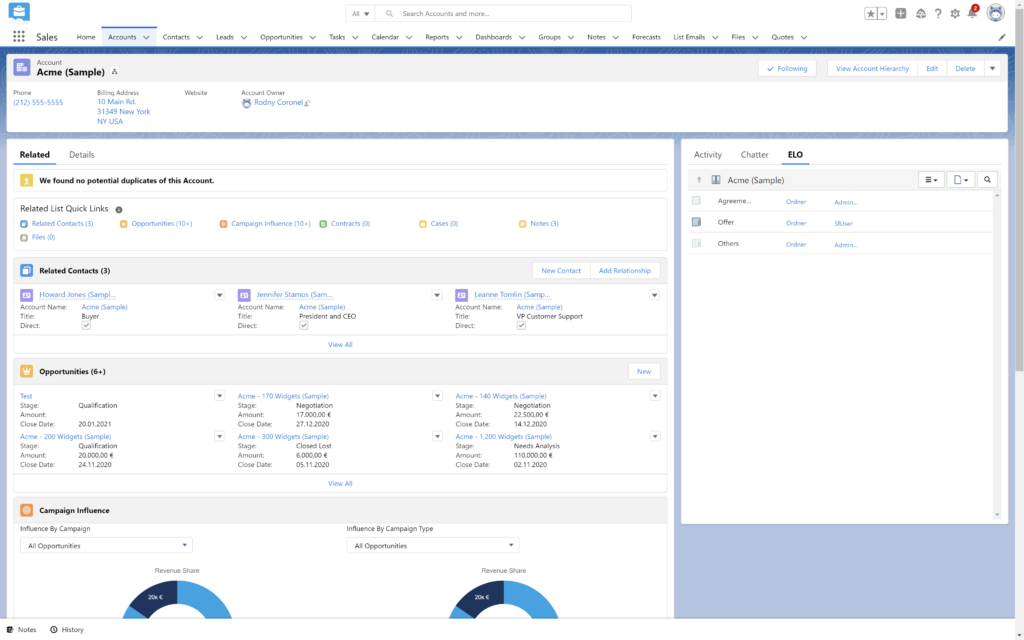
The integration of ELO with Salesforce provides companies with a comprehensive solution for document management. All relevant documents are stored in digital files that can be opened directly within Salesforce. This means that the sales, customer service, and finance teams always have access to the latest contracts, invoices, and customer communications.
Thanks to the smart search feature, documents can be found with just a few clicks. Full-text OCR search analyzes content and metadata, allowing users to search for specific keywords or parameters.
Special emphasis is placed on legal certainty and compliance. ELO ensures that documents are stored in a repository that is secure against tampering, with every change fully traceable. As a result, companies can comply with legal requirements such as GoBD or GDPR without having to implement additional systems.
Seamless integration with Salesforce and other systems ensures that companies can make the most of their existing IT infrastructure. Documents can be edited directly within Salesforce and linked to other systems, such as ERP or HR solutions.
Request a demo
Discover the advantages of ELO with our free demo and get answers to your individual questions.
In Conclusion: Why ELO Is the Best Choice for Salesforce
A reliable document management system is essential for any company that uses Salesforce as its primary platform. While Salesforce’s built-in features provide basic archiving options, specialized solutions like ELO for Salesforce enable efficient, secure, and automated document management.
With ELO for Salesforce, companies not only gain a centralized platform for their documents, but also advanced search and automation features that optimize business processes. Deep integration with existing systems and compliance with legal requirements make ELO the ideal choice for companies looking to take their document management to the next level.
Would you like to learn how ELO for Salesforce can support your business? See the benefits of our solution for yourself through a live demo and experience how easy it is to manage documents efficiently in Salesforce.

Stay up to date
Our free newsletter keeps you in the loop about new products, upcoming ELO events in your area, or about general trends and developments in the field of ECM.