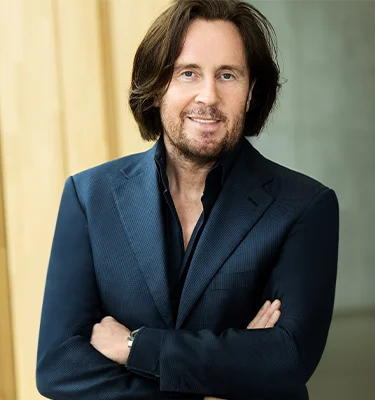
AI technologies are developing and an astoundingly rapid pace – we are witnessing the birth of a radical revolution. But to what extent is AI already transforming companies and their processes today? We discussed the subject with entrepreneur and AI expert Prof. Dr. Peter Gentsch.
Professor Gentsch, artificial intelligence is a major topic. How can AI transform SMEs, particularly in comparison to larger companies?
AI is not a brand new topic: We have been dealing with it for a while. The exciting thing is that AI can now also be used by SMEs. Testing AI within budgets and resources has never been as easy as it is today. I see this as a huge opportunity. We used to have to set up major projects, with data scientists and other experts – testing AI was expensive and required a lot of effort. Today, we are witnessing a sort of AI democratization. It’s becoming easier and cheaper – so I can implement things more quickly. And I think that situation is ideal for SMEs.
Are there specific departments within small and medium-sized enterprises that could benefit from AI? Could you name a few examples?
AI can optimize every department – from HR to accounting. SMEs in Germany definitely represent an important segment, particularly in the context of industry 4.0: Because we have an unbelievable amount of production data. However, we have to get from ChatGPT to “ActGPT” – meaning we have to develop models with which we can act and model, monitor, and orchestrate production processes. The Amazons, Googles, and Metas of the world can’t do that, because they don’t have these assets. The combination of new AI with industry 4.0 is a really exciting topic – in particular for German SMEs.
What challenges do you anticipate for companies using AI in business processes?
Data privacy is a topic that comes up again and again. It’s a serious issue, but it can be resolved if data privacy principles are integrated with the development and use of AI technology from the start. I think the biggest challenge is creating the mindset and admitting: “Yes, this is a game changer. This technology is changing our company, and we need to deal with it.” Perhaps bottom-up, so that employees work with GPT, for example, but also top-down, so that management is aware of what this new technology can do. It’s not a gimmick, but actually a base technology that will fundamentally change processes, companies, and markets. That’s why the responsibility for guiding and integrating AI lies primarily with management, and it should be a decision that comes from a CEO or executive level. The biggest challenge is convincing management to address the topic.
SMEs often have limited resources where R&D is concerned. What strategies do you recommend to still ensure a successful approach?
Firstly, a lot of AI applications are open source. There is a lot of technology that we can easily try out and play about with – so there’s no excuse there. What I’m also seeing in SMEs now is a lot of talent that wants to do just that. They may be familiar with using GPT privately and now they want to use it in the company. And this is precisely the talent I need to promote: You don’t need an IT or data science degree for that. Resources are a serious issue, but in terms of budget, I would say it has become a lot more cost effective to use AI. Where skills are concerned: Of course, we need to make sure employees have the skills, and there are excellent, free online courses that we can use for that. We often have highly motivated people who want to use the technology in companies. I would call on entrepreneurs to be a bit more courageous and also reach out to their own people. The resource issue can be easily dealt with in this way, particularly in small and medium-sized enterprises.
Should the workforce feel threatened by all these prospects? Do we need to worry about our jobs?
Jobs remain intact in all the AI projects we’re seeing. The media attention on AI and jobs can stir up concerns about a lack of skilled workers. But it is important to make a distinction when considering the effects of AI on the job market. In the long term, we will have new job profiles: The discussion here is about upskilling and reskilling. Certain professions will cease to exist – but new professions will be created. We just have to deal with it. When Microsoft Excel came on the market, people said it signaled the end for accountants and tax consultants. But today, we have more accountants and tax consultants than ever. Every technological evolution has seen us create more jobs, albeit different ones. We have to remain open and flexible enough in our minds to accept that. Those who resist change will need to reconsider their position – those who see it as an opportunity to redefine themselves and their job will have no need for concern.
What role do ethical aspects play in data privacy and the application of AI?
Ethics is an important topic, but it has been around since before AI. I don’t think we should open up an artificial discussion about this, rather we should apply what we have learned to AI. It goes without saying that a bot may not be allowed to be racist or sexist. However, the ethics council has stated that the decision-making authority remains with human beings. I believe that we could also hand over the authority in certain areas. I’m thinking about bureaucracy and administration: Wouldn’t we be happy if the processes here could sometimes run more quickly and efficiently? Many of the basic ethical, legal, and social questions connected to the use of AI already exist in other contexts. AI doesn’t really throw up a lot of new questions. We shouldn’t overload the issue, because I truly believe that sometimes, we have a somewhat romanticized image of human beings. We just have to learn that systems can sometimes do things better than we can as people. As far as military applications, social scoring, or medicine is concerned, there is no discussion: These are high risk areas where we need the highest ethical standards. But if an SME wants to install a service bot, then the bot can adhere to certain rules. We don’t need to make a big song and dance about data privacy and ethics in that case. It doesn’t help the situation.
Let’s finish by talking about the outlook: Where will we be in five years, what direction is development taking?
That is an incredibly difficult question, because development has never been as rapid as it is now. I have been working in AI for quite a long time, there have always been innovation and development cycles. However, what is happening at the moment is truly unimaginable. We are seeing new speech models almost every week, it’s almost impossible to keep up. That makes it very difficult to predict. I think we will see speech models that get better and better analytically. There will also be verticalization, i.e. industry-specific solutions. The general technology from Amazon, Google, and Open AI is highly generative and very good overall, however, specific solutions in certain industries will be much more frequent in the future – I think it will be a huge trend. And hopefully, we will also be able to resolve the data privacy issue in a reasonable manner, because that often presents an additional stumbling block. I hope the AI Act won’t hold us back in this exciting development.
There are also studies which indicate that the companies of tomorrow will have fewer employees – that may be the case. We will work more efficiently and productively – and we will have to reinvent ourselves to some extent. But a general artificial intelligence that is superior to human beings, in all honesty, we still won’t have that in five years. So, we can relax a bit there. I do believe that this technology will become more and more autonomous and take care of more and more tasks for us. But humans will still be in the loop for some time yet, I’m certain of that.
That’s a good point to end on. Thank you for the interview.
The interview was carried out by Stephan Buckenmaier during the ELO ECM Conference on March 6, 2024.
Peter Gentsch is a speaker, entrepreneur and scientist and has been a pioneer and top expert in the field of digital transformation, artificial intelligence (AI) and big data for decades. With numerous company start-ups and investments and five successful exits, he is one of Germany’s most successful internet entrepreneurs.