

From document management to modern information management
Mountains of paperwork and overflowing physical archives as well as ever-increasing amounts of data make it essential to implement a software solution that allows companies to manage documents. This is where software systems for document management (DMS), enterprise content management (ECM), or enterprise information management (EIM) come into play. But what are the differences between these systems, or do they ultimately stand for one and the same thing?
More efficiency with digital document management
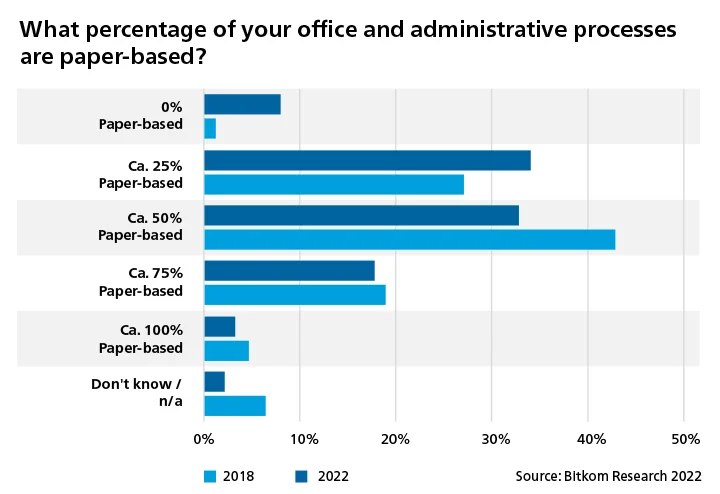
Many companies have already discovered the benefits of digital document management. According to the Bitkom Digital Office Index 2022, more than half of all German companies have already digitalized their paper processes. Over 40 percent rely on digital solutions in the areas of archiving and document management. Around half of companies are already using digital solutions to automate their processes. The benefits of digital document management systems are undisputed.
DMS, ECM, and EIM – Is there a difference?
When discussing digital document management and information in a business context, a variety of terms are used to refer to certain types of software systems. Here are some of the most important terms and abbreviations:
Managing electronic documents
This term refers to an IT system for organizing and processing electronic documents. According to this definition, a document management system does more than simply archive documents electronically since it also allows document-based business processes to be managed digitally.
Processing of all digital data and information in a company
The meaning of the term enterprise content management (ECM) goes beyond that of DMS by including all relevant data and information in a company and not merely what we typically think of as ‘documents’. In an ECM system, documents as well as other data and information can be stored, managed, and processed digitally.
Digital information management
Besides the ones already mentioned, there are a number of IT systems that are also used for digitally managing content and are frequently confused with document management or ECM systems. These include web content management systems (WCM) or, more generally, content management systems (CMS), which are often used for the digital management of smaller units of information, such as for creating websites or other types of media.
What about CMS and WCM?
Besides the ones already mentioned, there are a number of IT systems that are also used for digitally managing content and are frequently confused with document management or ECM systems. These include web content management systems (WCM) or, more generally, content management systems (CMS), which are often used for the digital management of smaller units of information, such as for creating websites or other types of media.
Documents and data provide the backbone
All the software solutions listed are based around one basic principle: the digital management and use of documents and data in a business context. The benefits of digital document management are obvious:
Automatic filing
A document management system allows companies to fully automate the process of filing documents.
Secure management
A digital document management system creates the best conditions for the regulatory-compliant storage of information.
Mobile access
You can access the digital document management system anytime and anywhere with a smartphone or tablet.
More transparency
When using digital filing structures and high-performance search functions, relevant documents and information can be found in a matter of seconds.
Save resources
With a digital document management system, you save storage costs and can use the space for something else.
Digital collaboration
Digital management of documents and information makes it easier to collaborate within a company – streamlined decision-making channels make it possible.
Five steps to digital document management
Digital document management can be visualized as a five-step process that starts with capturing the information on a document, storing and archiving it, to using it in various business processes.
1. Capture and scanning
Scanning paper documents and capturing documents that already exist in electronic form the basis for digital document management. Software-based character and text recognition systems (OCR) make the information contained in documents usable for digital purposes.
2. Processing information
After capturing the information, a document must be correctly classified so it can easily be retrieved. Every document is accurately described according to various criteria (creation date, author, references, text content, business data, etc.) and assigned corresponding additional data before being filed in an appropriate location in the DMS.
3. Secure data storage
Documents in the document management system are stored in accordance with a company’s own compliance guidelines and according to legal regulations for data retention, data protection, and privacy (GDPR).
4. Access control
Access controls and a sophisticated permissions system add additional levels of security for documents stored in the document management system. It’s possible to control access to individual functions, documents, or entire areas of the DMS.
5. Process automation
The automation of company processes using business-relevant documents offers significant added value to modern DMS solutions. From automated processing of invoices to the digitalization of HR processes and contract management, a document management system can offer companies a range of holistic benefits.
Moving into the digital future


The Italian state fund FONDIR has replaced its entire physical paper archive with a DMS, giving the company more space in its offices in the heart of Rome.
Not only that, but with the digital document management system, employees can find important documents and information much faster and can collaborate more flexibly at any time and independent of location, giving them a good basis for the next step into the digital future.
Enterprise content management systems can do more
Business processes such as invoice approval and personnel management can be digitally managed based on the electronic invoices, contracts, personnel files, and other documents stored in the DMS. Today, however, the options that are available for these documents are as varied as the different document types themselves. Colleagues need to be able to discuss documents, forward them, edit or approve them, and much more.
Systems for enterprise content management offer customized software solutions which extend far beyond the mere management of documents. In essence, it is about securely storing important information while also leveraging it for the success of your business. The ELO ECM Suite offers exactly this.



