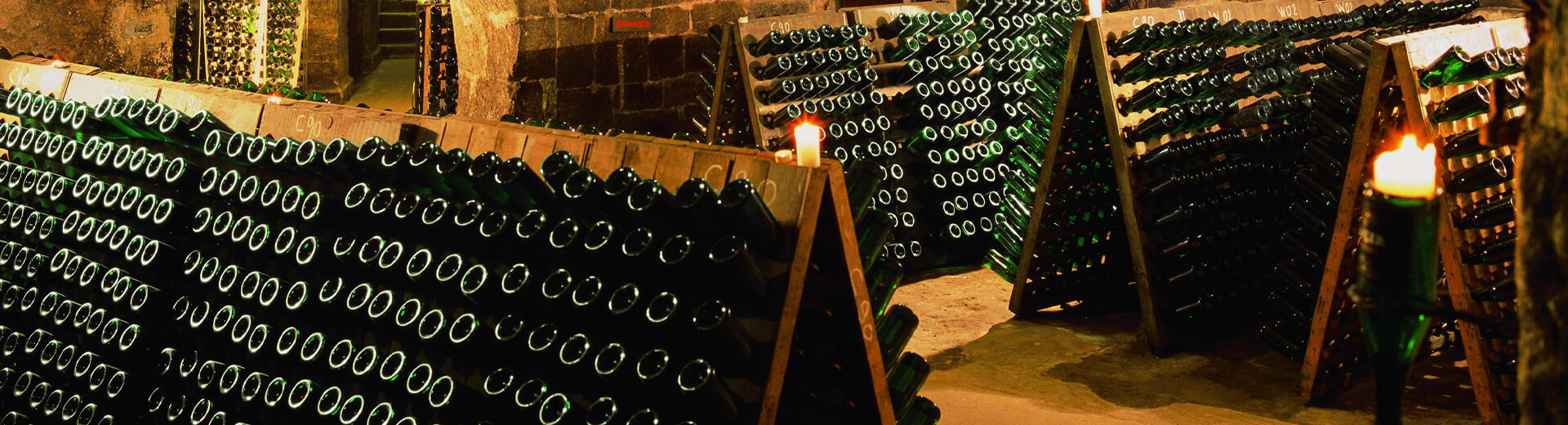
Quality is tradition at KESSLER Sekt – the “méthode traditionelle” for producing the best sparkling wine from the highest quality of wines from renowned vineyards across Germany and Europe has been applied here for nearly 200 years. At the same time, the company, founded in 1826, is looking towards a successful digital future with numerous innovations. How will enterprise content management (ECM) with ELO help shape this future? We talked to Kerstin Loy, the Commercial Manager at KESSLER Sekt GmbH & Co. KG, about just that.
Ms. Loy, Germany’s oldest producer of sparkling wines and digital business processes – how do those things go together, and how did you at KESSLER Sekt come across ELO?
In short: We were drowning in a figurative flood of paperwork. First of all because we at KESSLER Sekt have a decentralized organizational structure at both of our locations – administration is located in the historic old town of Esslingen, while production is about six kilometers away in Esslingen-Zell. Large amounts of paper are produced at both sites. Our elaborate business processes weren’t very efficient or transparent either. A bunch of our staff was busy almost exclusively with filing paperwork.
We mainly wanted to take a load off our employees so they can focus on more important tasks. Plus, it was our intention to lead Germany’s oldest producer of sparkling wines into the digital future. In sparkling wine production, we no longer work like we did 200 years ago, which was something we wanted to reflect in our administration.
What exactly was your digitalization goal and what challenges did you encounter?
We began by closely examining our order processing processes. This included analyzing all responsibilities, tasks, and steps of the individual employees. Until now, the process was as follows: All orders were entered at headquarters, printed, and transported to our production plant in Esslingen-Zell by truck. There, colleagues picked the orders and the delivery note wasn’t returned to the invoicing department at headquarters for several weeks in some cases. Things can easily be misplaced – not to mention all the time that’s lost.
Thanks to ELO workflows and an optimized ERP system, the orders are now visible on the order screen for colleagues in the picking department and are printed by date. All order documents are filed to the relevant order in the ELO system via defined order types. Additional order documents are scanned and transferred to the invoicing department electronically, where the invoicing process is started right away. Transparency helps us stay on top of things and the entire order processing process has been modernized.
In the second step, we scrutinized our purchasing process, asking ourselves: Can we streamline and map this process digitally as well? From my point of view, these considerations are the deciding factor for going digital within a company. Because you have to be aware of your own business processes and actively involve your employees in documenting these processes to successfully digitalize them with an ECM solution. So in my opinion, change can only succeed if everyone involved is working on it together right from the beginning.
You introduced ELO software right in the middle of the Christmas season, when you do the majority of your business. How did that work out for you?
After already having adjusted our organization in advance, we were very well prepared for the ELO solution to go live. We began introducing the digital process at the end of October, working with both the analog and digital processes at the same time for about six weeks – but ultimately migrating during the peak phase of our annual business went off without a hitch.
One major success factor is the users of the ELO solution. Plus, you don’t just introduce this kind of software alone – a systems vendor, that is an ELO Business Partner, was available for everything we needed in relation to the project. Our key users received excellent support and instruction. They were very actively involved in implementation right from the start and were in turn able to provide the other colleagues with the best possible support during the introduction.
What do you consider the main benefits of the ELO solution for your company?
ELO has helped us achieve higher efficiency and transparency in our key company processes – paving the way towards the digital future for Germany’s oldest producer of sparkling wines. Another major benefit of the ELO solution can be seen looking at our growing project business. An example: We recently launched a new webshop. First, we had to put together a functional specifications document and solicit bids – with the ELO software, this entire project can be mapped digitally, from filing the first offers to execution! We are also currently planning to open a new KESSLER shop in downtown Stuttgart. ELO will help us here too by mapping all of our documents and workflows in the ECM system. Everyone involved in the project has all the relevant information they need at all times.
Did the ELO solution help make your company more flexible and improve collaboration?
It really did. Besides the aspects I’ve already mentioned that information is now transparent and processes are much more efficient, the ELO solution can also be used on mobile devices. Thanks to ELO, we are already able to control a majority of the processes using laptops working from home. But we are also planning to get started on smartphones and tablets as well. In the future, the document chat function, that is the ELO feed, will help us avoid e-mail ping-pong and speed up approvals. This makes collaboration across departments so much easier.
So, what is KESSLER Sekt planning next on its digitalization journey?
We are currently working on introducing both the digital personnel file and contract management solutions. We then want to gradually map new contracts with suppliers and business partners digitally. Another larger project is rolling out a digital QM solution. We are IFS-certified and also want to map our entire quality management process in ELO in the future. Finally, we are planning to introduce the digital visitor management solution. As tours are once again possible at our headquarters, we want to optimize our safety standards with ELO Visitor.
We have lots planned with our ELO Business Partner. Our experiences have shown that preparation is the key to success when it comes to digitalization. Good consultation and support from an experienced IT partner is also essential.
The interview was conducted by Stephan Buckenmaier. He is Senior Manager Communication & PR at ELO Digital Office GmbH.
“Those who closely examine and clearly define their processes in advance will benefit significantly from the introduction of an ECM system”.