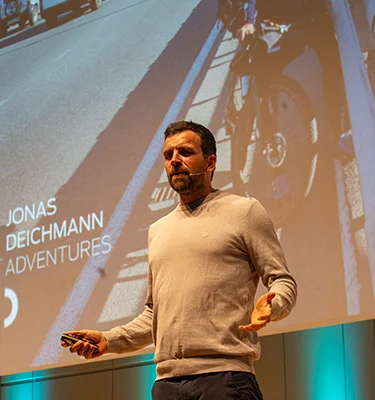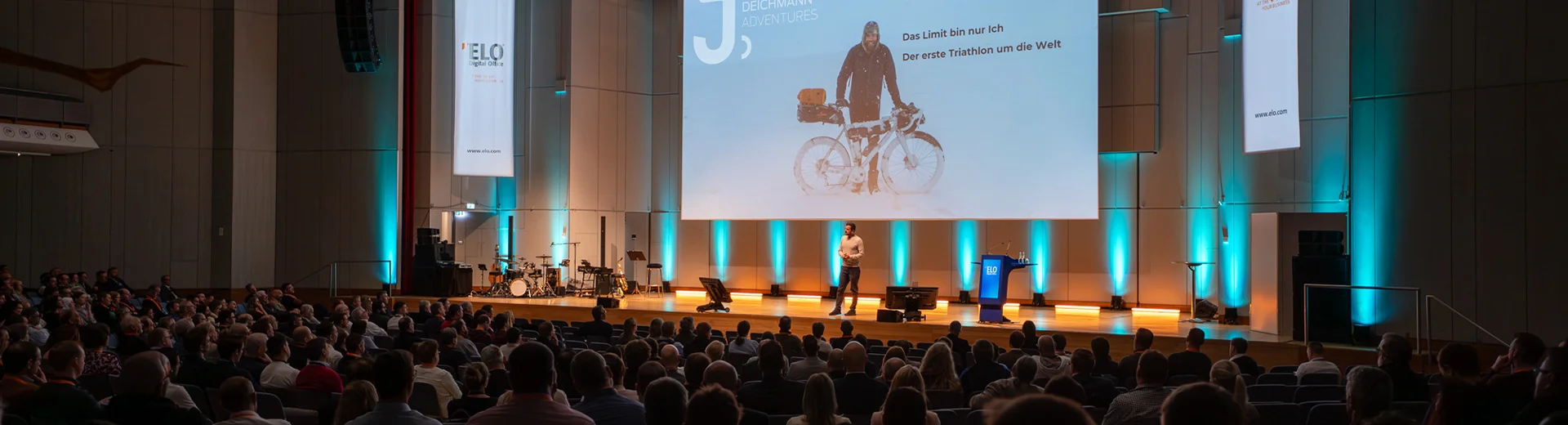
Extreme performance is the result of mental strength. Extreme athlete Jonas Deichmann showed us this impressively in his keynote at ELO HORIZONS 2026 in Stuttgart.
Afterwards, we had the opportunity to speak with the adventurer and multiple world record holder. We discussed mental strategies that help him keep going even under extreme conditions – and it became clear: Many of the principles that determine success or failure in an adventure translate surprisingly well to the work environment.
At the center of our conversation were topics such as staying focused, handling setbacks, using technology intentionally, and maintaining the ability to act, even in uncertain situations.
Dear Jonas – what mental strategy helps you most when you reach your limits – and how could this perhaps even be applied to everyday work life?
In what I do, mental strategies are absolutely crucial. They help me when I reach my limits. There are actually many parallels to the working world and especially to IT – because ultimately it’s also about project management. For me, every adventure and every world record is like its own project: I have a plan and prepare intensively. But in practice, it never goes exactly as planned.
The crucial question then is: How do I handle something going wrong? An important approach for me is to focus on small goals and milestones. While I have a big vision, I keep the day-to-day business very concrete in my mind. I sometimes say: I run from chocolate bar to chocolate bar – each small milestone is a reward and brings me closer to my big goal.
I have also learned to be comfortable with not being comfortable. Mental strength develops outside the comfort zone, and real growth occurs when you actively embrace challenges instead of choosing the easy path.
What role does technology play on your expeditions – and where do you intentionally choose simplicity instead?
First of all, I need the right equipment – starting with my bicycle. And of course I use technology, including a satellite tracker that provides an added layer of security in case of an emergency. If I run into trouble, I can use it to send out a distress signal so I can be located.
Navigation is equally crucial. When I’m out in the wilderness, I need to be able to rely on when I’ll reach the next village – and what kind of supplies I can expect to find there. If I’m crossing the Sahara and have inaccurate information about where to find water, it can be fatal in the worst-case scenario.
Beyond that, I now also use artificial intelligence. It helps me plan routes, gather information, understand political conditions, and manage overall logistics. AI makes my life on expeditions significantly easier.
What makes an adventure special, though, is that in the evening I’m often sitting by the campfire, and I deliberately leave my phone off. Of course, technology offers tremendous advantages: It makes life easier, helps plan adventures and projects more effectively, enables safer execution, and improves overall efficiency. But in critical moments, whether in a crisis or at a breathtaking campsite in a tent, it’s not about the technology – it’s about me. And it’s just as important to intentionally switch off your phone from time to time. Many of the best moments stay with me – not on a screen, but in my memory.
Was there a moment when you had to mentally hit reset or shift your mindset?
In my projects, even the best plan rarely works out exactly the way you imagined. Challenges always come up. For example, during my triathlon around the world, COVID hit. Suddenly, my entire route plan fell apart as borders were closed. I cycled through Siberia in the winter, then ran through Mexico – and every leg brought new uncertainties.
That’s why constantly replanning is just part of the process for me. I do have a plan, but I always know that I need to stay flexible and adapt. In situations like these, I follow the principle of radical acceptance: If my plan doesn’t work out, I accept it and focus on what I can do next. Complaining about it or getting frustrated over bad luck doesn’t get me anywhere. I focus on what’s possible and on the people around me who support me.
How do you deal with unexpected setbacks – the kind of “system failures” that can throw everything off track?
In my projects, I’ve experienced all kinds of setbacks. One example: I completed 120 Ironmans in 120 days. On day 54, I woke up with severe lower back pain. The idea of completing one Ironman, and then still having 65 more ahead, was anything but motivating at first.
I accept it for what it is, and I follow a simple rule: Just try. Often the anticipation is worse than the reality. As soon as I start my day, the body adapts – stretching out while swimming even makes it feel a bit better.
My projects have also taught me that better days are always ahead. If you can make it to the starting line – even when it’s really tough – and focus on small steps along the way, you’ve already taken the first big step in that direction. What matters is truly believing that better times are ahead.
What can teams in the IT world learn from your adventures about focus, prioritization, and perseverance?
There are a surprising number of parallels. Resilience is built above all when you don’t shy away from challenges, but actively take them on. My advice: Don’t get too comfortable. Seek out the next challenge – and run towards it.
What matters is breaking big tasks down into small, achievable goals. An extensive implementation or a complex development project can quickly feel overwhelming. But once you focus on each step and celebrate the milestones, you can really see the progress. And those are exactly the small wins you should celebrate – step by step, stage by stage. This boosts motivation and fosters a positive mindset.
Another important point is the language we use – especially in teams. Phrasing things in the conditional or using words like “actually” can subtly signal doubt. If I say, “We could actually develop that…,” it comes across as uncertain. Clearer and more effective is: “We’ll develop that.” Period.
That kind of clarity has a direct impact on the people around you – and on team dynamics. Those who speak with conviction inspire confidence. And that mindset is what makes the difference: We can do this. We’ve got this.
If that’s not a motivating note to end on – thank you so much for the interview!
This interview was conducted by Stephan Buckenmaier.
Jonas Deichmann is an extreme athlete, adventurer, multiple world record holder, and known as the “German Forrest Gump”. He holds multiple records in long-distance cycling and triathlon, including 120 Ironman-distance events in 120 days and cycling around the world. The Stuttgart native also works as an author and speaker.