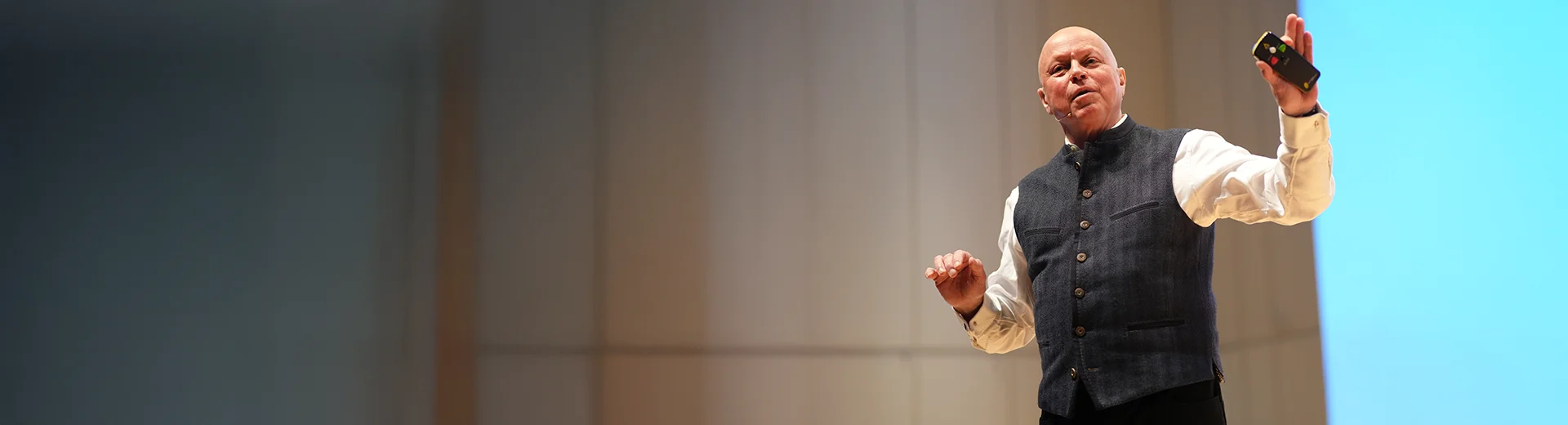
Digitalization is rapidly changing the way we live and work, but is it also making it harder for us to overcome our “inner resistance”? In this interview with Dr. Marco von Münchhausen, we take a look at the future of self-motivation. Our interviewee makes it clear: These challenges aren’t anything new. What has changed, however, are the ways we can get support. Digital tools can help us understand ourselves better and give us little boosts of motivation. But one thing remains the same: In the end, we still have to get up and get ourselves going.
Mr. von Münchhausen, in your keynote speech at the 2025 ELO ECM Conference, you talked about inner resistance and the challenge of self-motivation. In your opinion, can digitalization be more than just a distraction – can digital technologies perhaps even help us to overcome our inner resistance?
Well, of course digitalization can’t solve the underlying problem, our inner resistance. It’s deep inside us. But today, there are plenty of digital options that can help us to outsmart it to some extent.
I simply think of my step counter, as an example: When I come home in the evening and see that I’ve only taken 8,700 steps, although my goal is 10,000, I just go out for another walk. Little nudges like this work quite well for me. And that’s just one example. There are now countless apps that keep an eye on your health, measure your pulse, or help you exercise. The digital world can be a really helpful companion, especially for people who want to set themselves goals or develop certain habits.
Another important topic in your presentations is the ability to concentrate: The digital world brings with it a multitude of distractions for each of us. What strategies do you recommend to stay focused and concentrated in an increasingly digitalized world?
In many companies where I give seminars on work efficiency, this is a key issue. The first step is always to make the participants aware of what constant interruptions trigger in the brain. Because every time we are interrupted, whether by an e-mail, a ringing doorbell, or a message, we lose focus. This can reduce our output to a quarter of what we’d originally achieve.
For me, the key lies in what I refer to as “time islands”. In other words, consciously created phases in the daily routine in which you can put up some walls and really concentrate on your work without digital distractions. And this is possible everywhere, even in the hectic everyday life of a company. I call this the formula: no phone, no mail, no entry. Turn off your cell phone, close your e-mail program, perhaps forward the landline to a colleague. And if you have your own office, a simple “Do not disturb” sign – like in a hotel – will do the trick. In an open-plan office, headphones are often enough. Not only do they dampen the noise, they also send out a signal: no interruptions, please!
It is important that this is communicated openly within the team. If everyone knows that each person needs one or two hours a day to focus on their work, then this is also respected. And it’s amazing how much you can do in that time, even if it’s only an hour to start with. This allows us to take advantage of the benefits of the digital world without being paralyzed by its disadvantages. It’s not about completely opting out. It’s about regaining control.
How do you think these two topics – concentration and self-motivation – are connected?
Concentration and motivation are very closely linked. The ideal range for truly effective work lies between overload and underload – in other words, what I refer to as the flow channel. I’m pushed just enough, without feeling overwhelmed. I can enter a state of flow, where motivation and concentration are perfectly in sync. I’m completely in the zone, focused and fueled by a strong inner drive.
Studies also show that when people are in the zone, they are not only hyper focused, but also hyper motivated. One fuels the other – in this state, motivation and concentration go hand in hand.
Let’s take a look at companies: How can they help their employees to better cope with the challenges of the digital world and at the same time increase their productivity?
Basically, it’s about consistently implementing what I mentioned earlier. Namely, to ensure that all employees have dedicated time blocks during which they can work without interruptions and with full concentration. This requires two things:
Firstly, to inform employees of how interruptions affect their brains and their performance. Many people don’t even know how much their concentration suffers as a result, even though there are plenty of scientific studies on the subject. Creating this awareness is the first step.
And secondly: structure. Together with their teams, managers should clearly define a time when everyone can concentrate on their work – ideally once or twice a day for hour-long sessions. If this is agreed within the team, it will also be respected. That is how you make room for true focus in everyday digital life.
Finally, a look into the future: Will it become increasingly difficult to overcome our “inner resistance” as the digitalization of our personal and work lives advances?
I would say that it hasn’t become any more difficult, but you perhaps have to be more disciplined in setting specific times when you consciously avoid digital distractions. Otherwise, our nervous system is basically the same as it was in the days of the ancient Romans or Greeks. The capacity for self-discipline and to bring oneself to perform has always been a personal challenge, and digitalization will neither make this worse nor better.
What has changed, however, are the ways we can get support. The digital world today offers an incredible number of tools: learning videos, interactive platforms, webinars, all designed to help you acquire knowledge and better understand your own behavior. Digitalization is a real opportunity, especially for sharing information and raising awareness.
But you still have to get yourself out of bed. Even then, there are now digital coaches or fitness apps on our wrists that nudge us and say: “Hey, get moving, you wanted to exercise today!” That kind of little push can really help. But in the end, self-discipline always remains a central component – whether analog or digital.
Born in 1956, Dr. Marco Baron Münchhausen studied Law, Psychology and Communication in Munich, Geneva and Florence. Today, he is one of the most influential and successful entrepreneurs and is in high demand as speaker and coach in Central Europe and holds lectures on the topics of work-life-balance, self-motivation, stress-management, self-management, and utilization of personal ressources in German, English, French, Italian and Greek language.