Human versus machine – this negative juxtaposition is carted out whenever a new technology might replace human workforce in the future. However, this is simply wrong. Moreover, cooperation between people and technology is a the way of the future.
Written by Julia Thiem
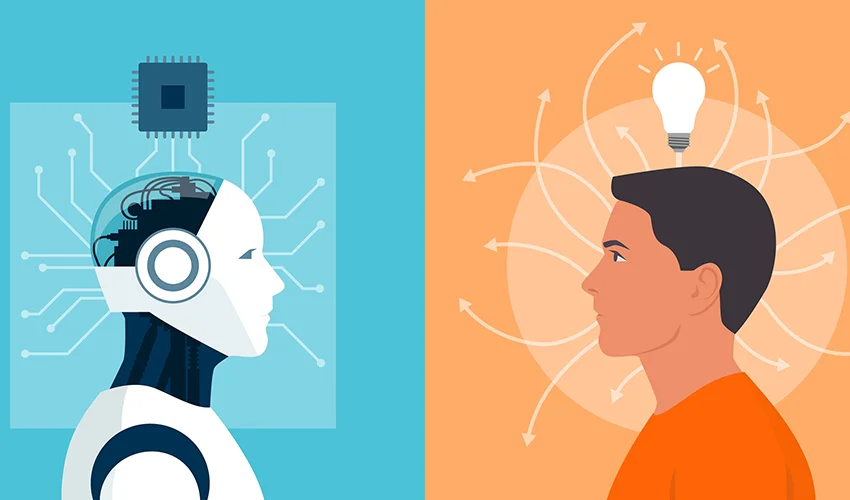
Digitalization transforms the workplace – this is obvious. But opinions are split on whether this is a positive or a negative development. Supporters of digitalization argue that technology primarily provides relief, whereas critics see robots as competitors to human labor and fear that it will lead to massive job loss and unemployment.
The truth is, as so often, somewhere in the middle. Experts from the consultancy firm Deloitte projected in their recent study “Jobs of the Future – the Workplace until 2035” (“Die Jobs der Zukunft – Berufswelt bis 2035”) that around 35 percent of the current labor time will be performed by machines in the future. Conversely, this means that 65% of labor time cannot be replaced by technology. And according to the consultants, it is exactly these jobs which will be in high demand in the future. Demand for employees for jobs which are less affected by automation will increase significantly faster than the number of jobs lost to automation. In total, they expect an increase by 1.3 million jobs.
Work will still be a part of life
It’s clear that there won’t be work environments without human workers any time in the foreseeable future either. Nevertheless, the jobs will change – for the better of the people. Tedious routines and repetitive tasks will be increasingly taken care of by technology, while people can show where they really shine: i.e. their analytical thinking and ability to interact with one another. At their research summit in Munich, the Society for Consumer Research (Gesellschaft für Konsumforschung, GfK) spoke of a farewell to the traditional society of wage labor and meritocracy, and in its place heralded the coming of a societal age based on meaning. Although (professional) life has never been easy, the world of tomorrow could very well be more fulfilling and make us happier.
But in order for this to be the case, we will need to set some new ground rules as highlighted in the Microsoft Work Trend Index 2022: According to the survey, an average of 35 percent of employees in Germany said their biggest challenge is knowing when and why to come to the office. At the same time, only 24 percent of decision-makers had developed guidelines for how hybrid working models can be implemented in their teams. Remote work obviously affects the collaboration between colleagues. 47 percent of employees in Germany with hybrid work models report having fewer friendships in their workplace since the shift to this mode of work. This reveals how important it is in a hybrid environment to support the forming of bonds between staff and to design onboarding processes for new colleagues in a way that the company culture will not suffer.

The right way to deploy technology
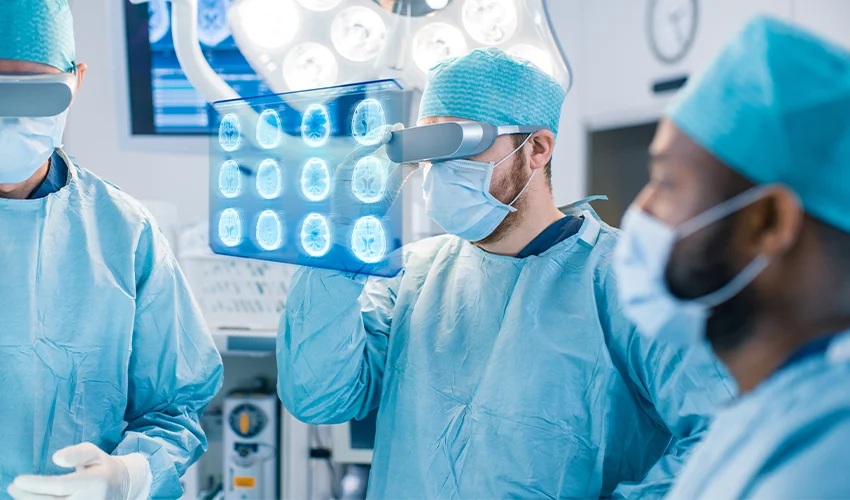
What these findings also show us is that digitalization is not an end in itself. New technology can only be advantageous and increase efficiency when implemented for and with people. Here too, new studies are showing that particularly the right combination of people and technology is the way of the future. One example is the results of a collaboration between researchers from MIT, the Harvard Medical School, and the Beth Israel Deaconess Medical Center from the year 2016. Their objective was to increase the detection rate for cases of metastatic breast cancer, and teams of pathologists and a deep-learning model together achieved a rate of 99% which was noticeably higher than with humans (96% detection rate) or machines (92% detection rate) alone.
This is called the human-in-the-loop principle and simply refers to models where human and machine intelligence work in tandem. It’s real teamwork. Humans are unmatched when it comes to making rational decisions with limited data, whereas machines can process gigantic volumes of data with unbelievable precision. Machines can’t make the right decisions based on intuition like humans can. The combination of both their strengths is what makes the future so promising.
And what about the here and now?
It will still be many years before these unstoppable teams of people and machines completely revolutionize the workplace. But both companies and their staff are already benefiting from a high degree of digitalization as was shown in a recent international survey conducted by the US market research group Gallup at the request of Amazon Web Services. Companies which primarily or partially conduct their business in the cloud are twice as innovative as companies which do not use the cloud (59% and 23% respectively) and nearly four times as likely to report steady growth (46% and 12%). Companies in Germany which are leading the pack in terms of digitalization were 56% more likely to have developed new innovative products over the past two years. Nevertheless, nearly 70% of companies say finding tech-savvy workers is difficult. 44% spoke of a lack of qualified candidates.
So instead of worrying about losing too many jobs, employees and companies should be doing what they can in preparation for the next phase of work. The Deloitte study tells us we will need more interaction. The jobs of the future will be characterized by human communication, teamwork, and empathy. The work will also be knowledge-intensive, and we must start building the foundation for these new, digital skills today.
Julia Thiem has worked as a freelance journalist and author for many years. She specializes in finances and digitalization and writes for business magazines and daily newspapers, among others.

“The future of work will involve less routine, more analytical thinking, and human interaction. If we take the right steps today, the work environment of tomorrow can be significantly more meaningful and fulfilling.”