When we think about the costs of incoming supplier invoices, our very first thought is the invoice amount. However, if a company receives a large number of documents each day, there are considerable invoice processing costs incurred, from receipt to filing. What does it cost to process an invoice, including the time it takes and the tools required?
What is the cost of processing a paper invoice manually?
Companies that have not yet introduced a solution for digitalizing invoices often claim this is because of the associated costs. However, paper documents also incur costs that need to be taken into consideration from an ROI perspective when deciding to make the digital switch.
Managing paper invoices means a considerable workload for accounting staff, as they have to enter all the information contained in invoices (supplier, amounts, date etc.) manually into the ERP system. This takes a lot of time, during which employees are not available for tasks which could add more value.
Moreover, entering invoice items manually represents a considerable risk of errors that can lead to incorrect payments and even payment delays and legal disputes. To prevent these types of complications, companies today are turning to digital invoice processes using intelligent software solutions that help to effectively optimize all aspects of invoice processing.
Advantages of digital, automated invoice processing
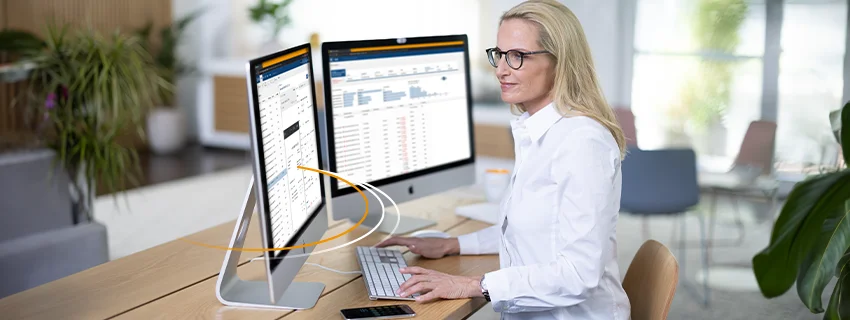
ELO can automate all these processes. Thanks to OCR (Optical Character Recognition) and ADR (Automatic Document Reading), the software recognizes all the necessary data and transfers this directly to the ERP system. Accounting then only needs to confirm the capture and initiate the transfer. And once invoices are correctly matched to a purchase order or a purchase requisition, this confirmation can even take place automatically.
This means more profitability and less time needed for processing and paying supplier invoices. Payments are made quickly (no more delays) and with a high level of precision, improving relationships with suppliers and helping to prevent legal disputes. Corrections are no longer necessary, meaning employees gain valuable time that they can use to increase their productivity.
What does it cost to process a digital invoice?
With a suitable solution, a digital invoice (whether received digitally, scanned from a paper document, or provided as an electronic invoice) does not require a physical storage medium to be processed by accounting. As no materials are required except for the computers used by office staff (and copy machines in the case of incoming paper invoices), no time is lost. This means lots of subsequent costs can be reduced or avoided with paperless invoices.
Getting rid of paper documents also reduces administrative costs. If all documents are immediately accessible at all workstations, without having to create a single copy, accounting can save a lot of valuable time. A suitable digitalization solution also reduces the costs for invoice processing by optimizing the way in which employees handle a document. Files that were archived many years ago can be found with just a few clicks.
Of course, digitalization requires an initial investment. But this is a one-off investment, and depending on the volume of invoices processed, it can very quickly pay for itself.
Last but not least, even though digital storage is not necessarily free, it does represent a significant cost saving in comparison to the cabinets and shelving required for archiving paper documents (and in some cases, even an entire room). Online archiving that can be extended in any way and simultaneously guarantees the continuous availability of all saved files, offers a lot of advantages. The costs of processing an invoice manually are generally estimated at 14 to 20 euros per invoice. The APECA association sets the cost of digital processing at between five and seven euros per document.
Electronic invoices will be mandatory from 2025
It should also be noted that the legal obligation for e-invoices presents the ideal opportunity to adapt to circumstances in which electronic invoicing will become the rule. Soon, electronic invoicing between companies will become mandatory, meaning each business needs to implement individual solutions that make this digital transformation easier.
Optimize your accounting with ELO Invoice, the software for electronic invoice processing.