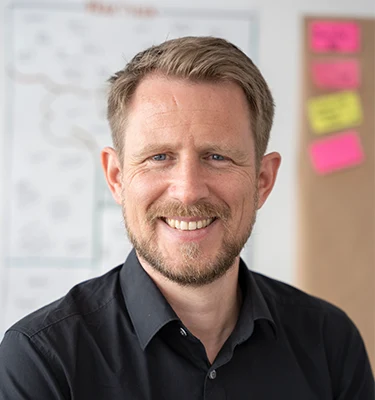
Agile coach? What is that, you might be wondering. Christian Richter’s job at ELO is actually easy to describe. An agile coach helps an organization and its people to better deal with the increasing complexity of new technologies, large number of innovative ideas, and a growing workforce. You could also say his role to drive agile transformation. Sound simple? With the right agile approach, it is.
Why is agility so important at ELO?
Maybe we should start by defining what agility is. Agility exists on different levels: in the mindset and values such as respect or openness between colleagues, in following principles such as self-organization or cross-functional teams, and in the use of frameworks such as Kanban or Scrum as well as agile practices such as user stories or Kanban boards.
Can you give us an example?
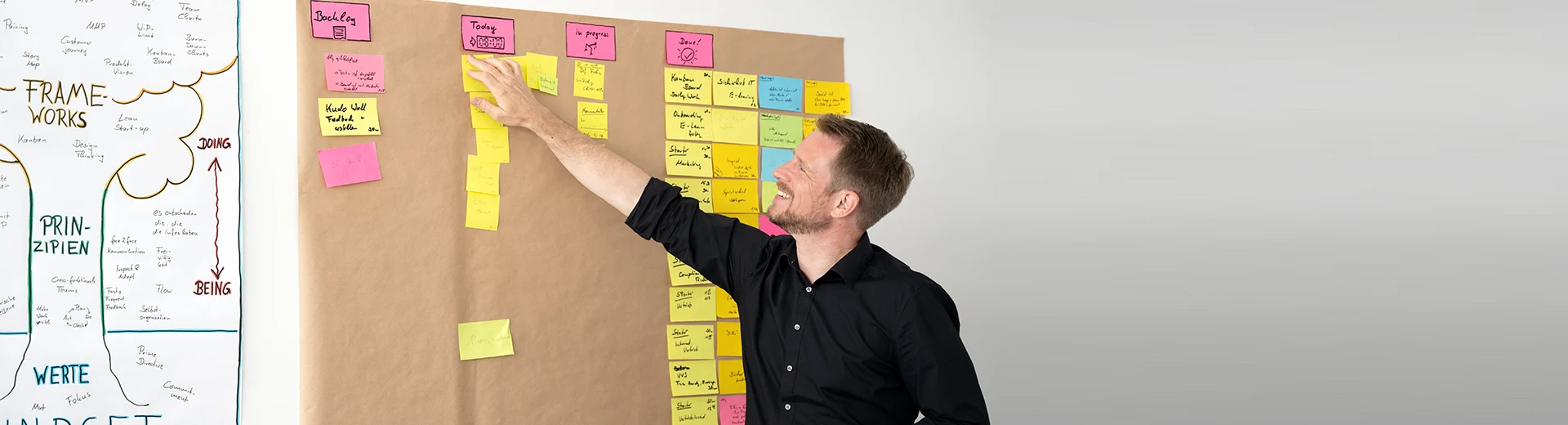
Transparency is probably a good example as it’s a principle that organizations are generally committed to. Embracing values such as courage and openness gives me a mindset that helps me to follow the principle of transparency. The frameworks provide methods that help to bring transparency to life. When I create a Kanban board that shows who is working on what and when, I am transparent about what is happening in a team. It can even be applied to the entire organization. Transparency helps me to recognize how I am progressing towards goals and where I currently stand and allows me to assess whether I need to realign goals. At the same time, transparency gives us the opportunity to continuously reflect and learn.
Is this mindset the same as the corporate culture?
Corporate culture refers to the values that define the nature of an organization and governs how its employees feel and act. In most companies, this is not restricted to the values of an agile mindset but is also shaped by other values. If these values conflict with a company’s agile values, agile transformation becomes more difficult, which means that the first step in the agile learning journey is to scrutinize these values. Examples of agile values includes openness, courage, commitment, respect, focus, feedback, and simplicity.
And what is the primary goal of agile transformation?
I think that we have multiple goals at ELO. The first is stability: Agility at ELO means having a stable product development process that can cope with increasingly complex requirements. Secondly, by getting multiple stakeholders on board, agility fosters innovation. The third goal is resilience in the sense that agility enables the organization to respond quickly to external factors that would otherwise be a risk to the company. And last but not least, agility is a feature of a modern workplace, making ELO an attractive employer in times of skills shortages. All of this is important, because management is not only responsible for the here and now, but always has to be conscious of how ELO will be doing in two, five, or ten years.
ELO isn’t starting from scratch but has a large employee base with established structures and processes. So where do you begin?
Fortunately, I’ve been an agile coach for most of my professional life and have gained vast experience with people and their organizational structures in social systems. True to the agile principle of “Start where you are”, it is important to be appreciative of processes that work well and find ways to evolve them. We start off by experimenting in small pilot teams. Some things we decide to continue, while other ideas are abandoned depending on what is the right fit for the company and its objectives. Besides applying the “Start where you are” principle I’ve already mentioned, we also implement “inspect and adapt” with the knowledge that there is no blueprint. Every organization has to find the way that is right for them.
My job is to help teams find the right direction, act as moderator, lead workshops, and provide structures – basically lateral leadership, which means leadership without formal authority. And I ask a lot of questions. Questions that encourage people to organize themselves, help them to identify their own resources, and develop individual solutions.
Is that where your job title “coach” comes from, because it’s like being a coach who delivers strategy and tactics from the sidelines?
I’m not comfortable with that image because I’m only a trainer a small percentage of the time. I’m more of an enabler. The others are the experts. I only make transparent which processes and structures can be used to attain a goal. A more appropriate image is that of a midwife in my opinion, who, as I know from the birth of my own two children, is essentially there to provide ideas and help the mother to find the best possible way to bring a baby into the world. The birth itself is still the job of the mother. And that is exactly why men can also be midwives or women who are not or not yet mothers themselves. You don’t have to have given birth to a child to be able to offer the right strategies and solutions to help an expectant mother. And as an agile coach, I don’t need to be able to program software to help teams at ELO achieve their goals.
What advice would you give to companies who are just starting an agile transformation?
One of the most effective methods is to start off small and form individual agile teams and projects. This is in line with agile principles such as “incremental and iterative development”, “simplicity”, or “make work visible.” Start off small, continuously adapt and improve, make successes tangible, let the resulting enthusiasm spread throughout the organization through word of mouth. This way, we are also building an agile community where employees can get involved in agile topics and exchange ideas.
What was your motivation for pushing agility at ELO?
Even before I joined the company, I had the opportunity to get to know ELO in different contexts. One of the reasons I came on board was that I noticed there is a strong sense of teamwork and willingness to help. This is excellent starting point for successfully implementing agile. Another extremely positive aspect: ELO is a company with a healthy mix of older, experienced employees and a younger generation. That’s a strong foundation for transformation.
“Agile, at its core, is a process of continuous improvement, learning from experience, and enhancing methodology and team performance.”