

It is often reported that Germany is not a front runner when it comes to digitalization. But why is that? A country with a solid economy can’t be that far behind when it comes to digitalization, can it? With the onset of the Covid-19 pandemic, digital transformation picked up and efforts to make the digital economy more competitive increased, albeit not enough. Germany has failed to harness the digital revolution, while the rest of the world has overtaken us.
Written by Delia Alf
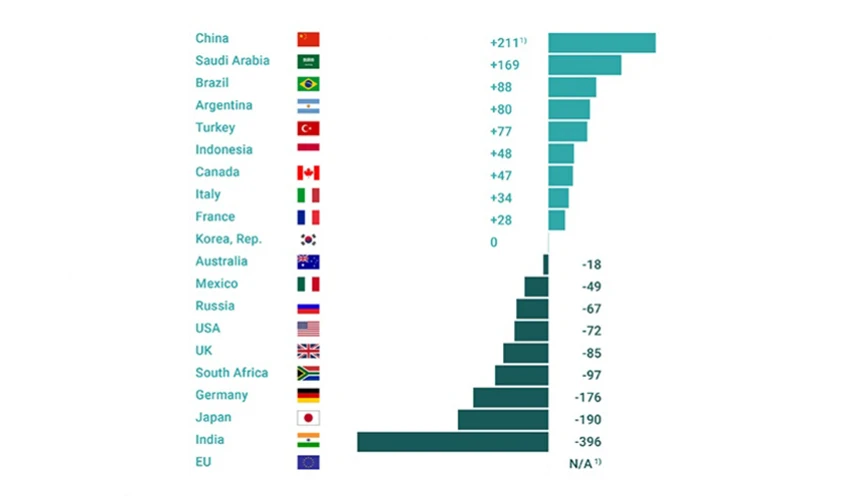
The Digital Riser Report 2021, published by the European Center for Digital Competitiveness at ESC Business School in Berlin, shows that Germany ranks third to last among the G20 countries, and second to last among the seven most important industrialized nations. The report analyzes and ranks the changes that countries around the world have seen in terms of their digital capabilities over the past three years. The latest digitalization index released by the German Economic Institute likewise confirms Germany’s low digital performance. The index is created based on a number of different factors.
Why Europe’s largest economy is lagging behind in technology
Internal and external aspects are used as a basis for calculating the index. The external factors include the technical infrastructure, the administrative and legal framework, society, human capital, and the innovation landscape. To pave the way for full-scale digitalization of the German economy, cities and municipalities need an intact and good infrastructure. This is especially a problem in rural areas. Moreover, the federal states often lack the financial resources to cover the costs of transitioning from analog to digital. Concerns for data privacy remain a major issue. Strict data protection regulations and bureaucracy are hindering the progress of digitalization.
From an internal perspective, business models, qualification, products, processes, and research and innovation activities are important. The pandemic gave remote networking a boost for the simple reason that people would otherwise not have been able to work from home. On the downside, it slowed digital transformation. Many companies abandoned their digitalization projects in order to conserve financial resources. In addition, there is not enough IT talent to meet the high demand for these skills. Due to a lack of qualified IT specialists and developers, companies are unable to digitalize processes quickly and prep their workforce accordingly.
Digital readiness in other countries
France and Italy have made comparatively good progress on the digitalization front in recent years and currently rank among in the top ten of the G20 countries. Further east, countries such as Romania, Poland, and the Czech Republic, which have much smaller economies than Germany, are better positioned digitally. The countries are assessed individually as well as in relation to other specific aspects. Germany ranks poorly in relation to its own GDP, internet costs and quality of service, whereas countries such as Romania fare much better here in comparative terms.
Public administration in Germany is an extreme reflection of the current state of digitalization. Processes are complex and outdated. Applications and appointments take a lot of time, not to mention a huge amount of paper. There is an acute need for action. Enterprise content management (ECM) systems alleviate the problems by providing administrative bodies with a secure IT system that automates paper-based processes and stores relevant data centrally.

Digitalization in the future
Despite the slow advance of digitalization in Germany, the year 2023 looks promising, and is set to be a key year for the metaverse. The metaverse offers virtual meeting and training spaces and break rooms where employees from different geographies can get together. In addition, companies are increasingly looking towards low-code platforms and artificial intelligence. We are on the cusp of an exciting era in which digital transformation is non-negotiable. Politics, society, and the private sector need to rethink their approach to digitalization so as not to get left behind.

Digitization in Germany is progressing only slowly. Large companies are significantly more digitized, while SMEs in particular have some catching up to do in terms of digital transformation.



