Move to the cloud or stay on-premises? An ever growing number of companies are asking themselves this question. Because cloud products, and in particular business applications from the cloud, have both advantages and disadvantages that need to be considered. Here are some pointers to help your company find the right path.
Written by Jürgen Kroder
With SaaS to a cloud-centric company
The cloud – it seems to mean everything and nothing. The cloud is a collective term for lots of different technologies and solutions. If we are only talking about web applications, we refer to Software as a Service, or SaaS for short.
SaaS has been around almost as long as the Internet. If you log on to your e-mail inbox online, or make changes to your website using an editing system, you are using SaaS technology – the same as if you save your private photos in cloud storage or write your ideas in an online text editor program. Even the ELO enterprise content management system you use to easily manage documents and other data can be operated in the cloud.
Did you know?
The idea of Software as a Service goes back to the 1960s, when mainframe computers were connected to terminals and shared access to software. But it was only in the 1990s, when the Internet became established in the mass market, that the concept was developed further and the abbreviation SaaS was coined. So Software as a Service isn’t virgin territory, rather an established way of using business applications, among other things.
Advantages: The benefits of business applications from the cloud
Cloud programs come with more advantages than disadvantages. Here are the biggest advantages:
Easy access
As SaaS applications run in the cloud, you don’t usually have to install anything on your device. All you need is stable Internet access and a browser – that’s it! It doesn’t usually matter if you use applications on a Windows PC or a Mac, on a tablet, or a smartphone.
Remote access
A lot of cloud programs can be used in a browser and also as apps. In this case, you can choose to carry out your tasks on a stationary computer in the office, a laptop working from home, or on the train using a smartphone. You always have access to your data – for example, your current business documents – from anywhere, as everything is synchronized centrally over the Internet.
Always up-to-date
Applications from the cloud are always fully up-to-date, as updates are carried out automatically. The cloud provider takes care of that for you. So you benefit from the latest functions and security measures.
A high level of data security
Customer data is a cloud provider’s most valuable asset. That’s why they generally use the latest security technology to protect business applications and all the user data. This includes special defense and back-up mechanisms that keep failures and data loss to a minimum.
Outsourced infrastructure
Is your IT infrastructure powerful enough? Do you need a new server? Who takes care of patch management? You don’t need to worry about these questions with Software as a Service. A cloud provider will take care of the infrastructure, ensuring that the application runs perfectly. This saves you time, resources, and costs.
Flexible subscription models
As far as costs are concerned: Most business applications from the cloud are based on a pay-per-use or subscription model. That means you only pay for the programs for as long as you use them. Do you want to use a cloud application for three and a half years or less? No problem – most cloud providers offer flexible usage models.
Working collaboratively
The Internet was invented to connect people across the entire world. This philosophy is also reflected in most cloud programs: Teams can work on documents simultaneously or exchange information in real time, no matter where individual members are. This promotes collaboration beyond borders.
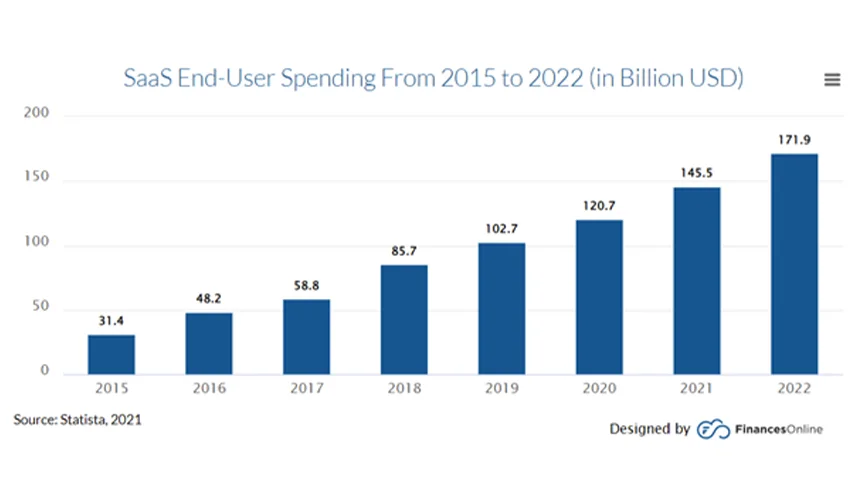
Software as a Service is on trend
The SaaS market has been growing continuously for many years. Around 172 billion US dollars were spent on cloud applications worldwide in 2022. We can assume that this trend will continue.
The disadvantages of business applications from the cloud
Nonetheless, there are some aspects of on-premises that are beneficial. So you should check what’s relevant for your decision.
Internet bottlenecks
You need a stable and fast Internet connection to use Software as a Service effectively. If the available connection is insufficient, an internal installation may be preferable.
Service availability
If a cloud provider has problems with its infrastructure, there will be failures. Or even worse: If the cloud provider files for bankruptcy, this dependency will present a risk.
IT security and data privacy
Central cloud services are often popular targets for cyber attacks. In the event of highly sensitive data, this may therefore be a reason to keep it locked up in-house and shielded from the public Internet – for example, important construction data.
From SaaS to a cloud workstation
A web application here, a cloud subscription there: If you or your company are open to this type of software use, you will soon be able to access an increasing number of business tools via a browser. Your workplace is figuratively moving more and more into the cloud. This means taking care of internal servers in-house is becoming less of an issue, and that has a positive effect on the usage of your own IT resources.
The introduction of cloud workplaces is also stimulating digital transformation: Remote work, work from home, and other types of working will become a lot easier and faster, as almost no labor-intensive internal IT projects (hardware procurement, installation, etc.) will be required. So it is becoming less and less important where the individual team members are, whether in the office, at home, or in a cafe at the other end of the world. Welcome to new work.