

Artificial intelligence is becoming more widespread – especially in the business realm, where it is already helping companies in so many ways.
Written by Jürgen Kroder

The hype surrounding AI
Artificial intelligence, or AI for short, has become a buzzword that IT experts, marketing specialists, and even politicians commonly refer to.
AI is associated with high expectations of a world made better thanks to smart robots and other automation applications. Dystopian scenarios involving machines taking over the world are also being presented. Neither of these present a true picture.
The reality is that AI helps workers to do their tasks in a better way.
What does artificial intelligence mean?
John McCarthy, a computer scientist and author, coined the term artificial intelligence in 1955. Although AI has been discussed and worked on for years, there is still no clear definition.
Artificial intelligence stands for technologies that are supposed to mimic human capabilities such as learning, logical reasoning, or creativity, and ideally to do so faster and more effectively than the human brain. AI is also an umbrella term to express different forms of intelligent behavior in IT systems and machines. Types of AI include weak AI, strong AI, deep learning, machine learning, and neural networks.
AI software or algorithms are usually weak AI. However, these are sometimes so smart that they appear to be intelligent, even if they are not remotely capable of thinking and acting like humans.
How widespread is AI in the business realm?
That depends on what you define as AI. Do e-commerce recommendation algorithms or the Alexa voice assistant count as artificial intelligence? Or does it only really start with self-driving cars and the like?
Without the facts and figures, it’s evidently hard to make a clear distinction, which is why there are so many different studies based around this topic.
What is certain, however, is that more and more companies are experimenting with various forms of artificial intelligence to improve their hardware and software. This is because AI is an exciting and promising field that has the ability to businesses a competitive edge. AI research and use is also subsidized with grants, including an initiative by the European Commission.
Where is AI in use today?
Smart applications are increasingly becoming part of everyday business. It’s often done in baby steps: AI-based voice assistants automate customer service hotlines, while chatbot systems provide useful advice for website issues, or a fashion AI helps us to finds the right outfit to match our size or personal tastes.
Voice assistants are also gradually becoming the norm. We can complete tasks just by getting out our phones and saying, “Hey Siri, send a WhatsApp message to …”, or “Alexa, order printer ink for …”. We are all familiar with voice search technology in navigation and entertainment systems in vehicles, which allows us to calculate routes and select music tracks by voice command.
Analyses and forecasts are one of the strengths of machine learning and co. Financial forecasting software uses data sets, some of which are highly complex, to predict sales. And predictive maintenance detects machine failures before they actually happen.
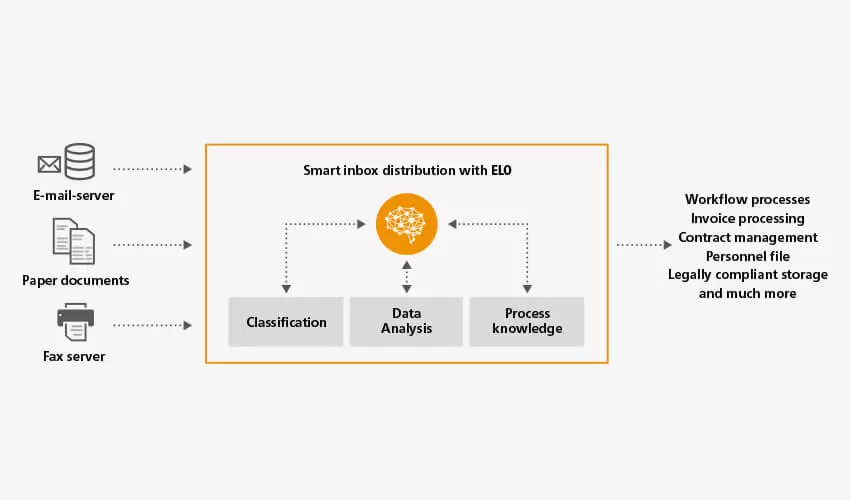
Accounting is another field where AI is increasingly making its mark. For example, the latest accounts software systems map payable and receivable invoices to account transactions. And intelligent analysis and classification tools such as ELO DocXtractor recognize document contents and automatically match them to the correct business processes. This way, accounts receivable invoices are automatically routed to the approval workflow.
More about digital mailroom with ELO >>
What are the benefits of using AI in business?
Artificial intelligence is part of the field of digitalization. Digitalization, also referred to as the Fourth Industrial Revolution, offers a wide range of benefits. The primary goal is usually to improve efficiency.
AI systems can be used in the workplace to delegate complicated, monotonous, or recurring tasks to a “machine”. These technologies are capable of scanning and routing documents automatically – fully or partly – at high speed 24 hours a day, 365 days a year.
For businesses, AI support means that specialist workers, who are becoming increasingly difficult to recruit in the war for talent, can dedicate their valuable time to more creative skills instead of wasting it on routine tasks. This gives them more time to devise new business strategies or develop innovative products, for example. And because deep learning, machine learning, and co. are capable of collecting and analyzing large amounts of data, they can be used to implement entirely new business concepts.
Another key aspect is that AI is self-learning. Errors are continuously corrected, improving results and ensuring greater efficiency.
What are the disadvantages of AI?
Nobody’s perfect, and the same can be said for artificial intelligence. For the most part, AI and research into the topic is still in its infancy. The systems are still a long way from having truly intelligent capabilities, yet progress is rapid, even unprecedented in some areas. In just a few years, AI could be making giant leaps.
As long as AI is not smart enough to act on its own, some applications need to be continuously monitored and adapted by humans. This costs time and resources. The same applies when companies are implementing AI solutions, which is why many have decided to sit back and wait to see how the market takes shape.
Another obstacle is that many people have reservations about AI technologies. Some fear that their jobs could be replaced by robots. This kind of resistance can delay or obstruct the introduction of AI systems.
How should we deal with AI?
Good artificial intelligence opens up new opportunities for single departments or an entire company to drive processes. In addition, countless new jobs have been created in the AI field, such as in research, programming, and implementation.
AI systems also simplify a whole range of activities. Who wants to sit and punch in numbers all day or waste time on the phone trying to get information? Artificial intelligence can be a great assistant when it comes to making tasks more pleasant to complete.
We shouldn’t see AI in the workplace as the enemy, but as a tool that allows us to fly through menial tasks!

Intelligent analysis and classification tools such as ELO DocXtractor recognize document contents and automatically match them to the correct business processes.



